

KATHMANDU - POKHARA - GHILING - MANTHANG - GHAMI - KAGBENI - JOMSOM - POKHARA - KATHMANDU




Why Upper Mustang Trek?
- Explore Lo Manthang – Discover the historic walled capital of the former Kingdom of Lo.
- Visit the Royal Palace – See the historic palace and royal heritage of Mustang.
- Discover Chhoser Caves – Explore fascinating ancient caves carved into dramatic cliffs.
- Visit Luri Gompa – Discover a remarkable Buddhist cave monastery surrounded by rugged landscapes.
- Explore Tashi Kabum – See ancient Buddhist murals and chortens hidden within the Mustang cliffs.
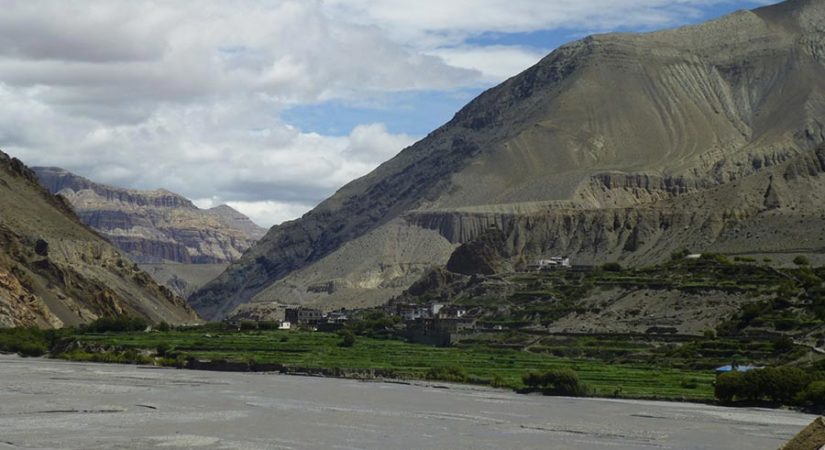
- Experience the High-Altitude Desert – Trek through barren valleys, colorful cliffs, and dramatic rock formations.
- Visit Ancient Monasteries – Experience centuries-old Buddhist monasteries, murals, and sacred monuments.
- Walk Through Traditional Villages – Experience the unique architecture and lifestyle of Mustang’s mountain communities.
- See the Red Cliffs of Dhakmar – Admire the striking red and ochre cliffs surrounding this traditional village.
- Follow the Kali Gandaki Valley – Trek through one of Nepal’s most dramatic trans-Himalayan landscapes.
- Experience Tibetan Buddhist Culture – Discover ancient traditions, prayer walls, chortens, and local religious practices.
- Enjoy Himalayan Mountain Views – Admire panoramic views of the surrounding Mustang and Himalayan ranges.
Overview of the Upper Mustang Trek
The Upper Mustang Trek is a unique adventure into Nepal’s remote Himalayan region, covering approximately 160 km through dramatic landscapes, ancient villages, caves, monasteries, and traditional Tibetan-influenced culture. Trekkers typically walk 5–7 hours per day, covering around 10–15 km, with the complete trek generally taking 12–14 days, depending on the itinerary and acclimatization days.
As Upper Mustang is a restricted trekking area, a special Upper Mustang Restricted Area Permit is required. The permit costs USD 500 per person for the first 10 days, with an additional daily fee for extensions. Trekkers also need an Annapurna Conservation Area Permit (ACAP) before entering the region.
Upper Mustang Trek Introduction:
The Upper Mustang Trek is one of Nepal’s most fascinating Himalayan adventures, taking you into the remote and culturally rich Mustang region north of the Annapurna and Dhaulagiri mountain ranges. Once the independent Kingdom of Lo, Upper Mustang has preserved a distinctive Tibetan-influenced culture, ancient Buddhist traditions, historic monasteries, and traditional villages.
The trail follows ancient routes through a spectacular high-altitude desert landscape, with dramatic cliffs, colorful rock formations, deep gorges, caves, and fertile villages surrounded by barren mountains. Lo Manthang, the historic walled capital of the former Kingdom of Lo, is the cultural highlight of the trek, where you can explore its narrow streets, monasteries, traditional houses, and centuries-old Tibetan Buddhist heritage.
One of the major advantages of the Upper Mustang Trek is its location in the rain shadow of the Annapurna and Dhaulagiri ranges, making the region suitable for trekking even during Nepal’s monsoon season. Along the journey, you can enjoy panoramic Himalayan views and experience a landscape and culture very different from other popular trekking regions of Nepal.
The trek can also be combined with Muktinath and other routes in the Annapurna region, making it an excellent choice for travelers looking for a remote Himalayan experience, ancient Tibetan culture, and a less-traveled side of Nepal.
Best Places to Visit and Things to Do During the Upper Mustang Trek
The Upper Mustang Trek offers remarkable places to explore, including the ancient walled city of Lo Manthang, historic Buddhist monasteries, caves, chortens, and traditional villages with mud-brick houses. Trekkers can also enjoy spectacular views of the Annapurna, Dhaulagiri, and Nilgiri mountain ranges while walking through dramatic high-altitude desert landscapes.
During the trek, you can experience the region’s unique Tibetan-influenced Buddhist culture, cross scenic mountain passes, explore ancient settlements, and learn about the traditions of the people of Mustang. If your trip coincides with the Tiji Festival, you can also witness one of Lo Manthang’s most important traditional Buddhist celebrations, making the journey an even more memorable cultural experience.
How to Prepare for the Upper Mustang Trek
Preparing for the Upper Mustang Trek involves building your physical fitness, preparing mentally for several days of walking, and getting ready for high-altitude conditions. Regular activities such as walking, hiking, running, cycling, or swimming can improve your stamina and endurance. It is also helpful to include uphill and downhill walking in your training, as the trek involves varied terrain and mountain passes.
Proper preparation also means having the right trekking gear and clothing, including comfortable trekking boots, warm layers, a waterproof jacket, gloves, and a suitable sleeping bag. Be prepared for basic teahouse accommodation, changing weather, and the dry, windy conditions of Upper Mustang. Allow enough time for acclimatization, carry travel insurance that covers high-altitude trekking, and make sure you have the required Upper Mustang Restricted Area Permit and other necessary permits. Traveling with an experienced guide or trekking company can also make the journey safer, more comfortable, and easier to manage.
Upper Mustang Trek Permit Cost
You need the following permits for the Upper Mustang Trek:
- Upper Mustang Restricted Area Permit: USD 500 per person for the first 10 days
- Additional days: USD 50 per person per day after the first 10 days
- Annapurna Conservation Area Permit (ACAP): NPR 3,000 per person for non-SAARC nationals
- SAARC nationals: Different permit rates may apply
Permit fees can change, so it is best to confirm the latest rates before starting your trek.
Upper Mustang Trek Difficulty and Risks
The Upper Mustang Trek is considered a moderately challenging high-altitude trek that involves long days of walking, steep ascents and descents, and several mountain passes. The dry and remote terrain can make some sections physically demanding, so a good level of fitness and proper preparation are important. Altitude sickness is also a potential concern, and it can affect trekkers regardless of age or fitness level, making gradual acclimatization essential.
Weather conditions can change quickly in the mountains, with strong winds, cold temperatures, and difficult conditions at higher elevations. Upper Mustang is also a remote region with limited medical facilities and communication services in some areas. Trekking with an experienced guide, carrying appropriate clothing and equipment, staying properly hydrated, allowing enough time for acclimatization, and having suitable travel insurance can help make the trek safer and more enjoyable.
Upper Mustang Trek Weather in Spring and Autumn
Spring (March–May) brings mild days, clear mornings, and cold nights in Upper Mustang. The landscape becomes more vibrant as vegetation and wildflowers begin to bloom. Higher elevations remain cold, especially early in the morning and after sunset.
Autumn (September–November) offers generally stable weather and excellent mountain visibility. September can still have some changing weather after the monsoon, while October and November are typically drier and clearer. The villages and fields also become lively during the harvest season.
Temperatures vary significantly with altitude and time of day. Pack warm layers, a waterproof jacket, sun protection, gloves, and a warm sleeping bag. Mountain weather can change quickly, so being prepared for cold, wind, and occasional precipitation is important.
Upper Mustang Trek Outline
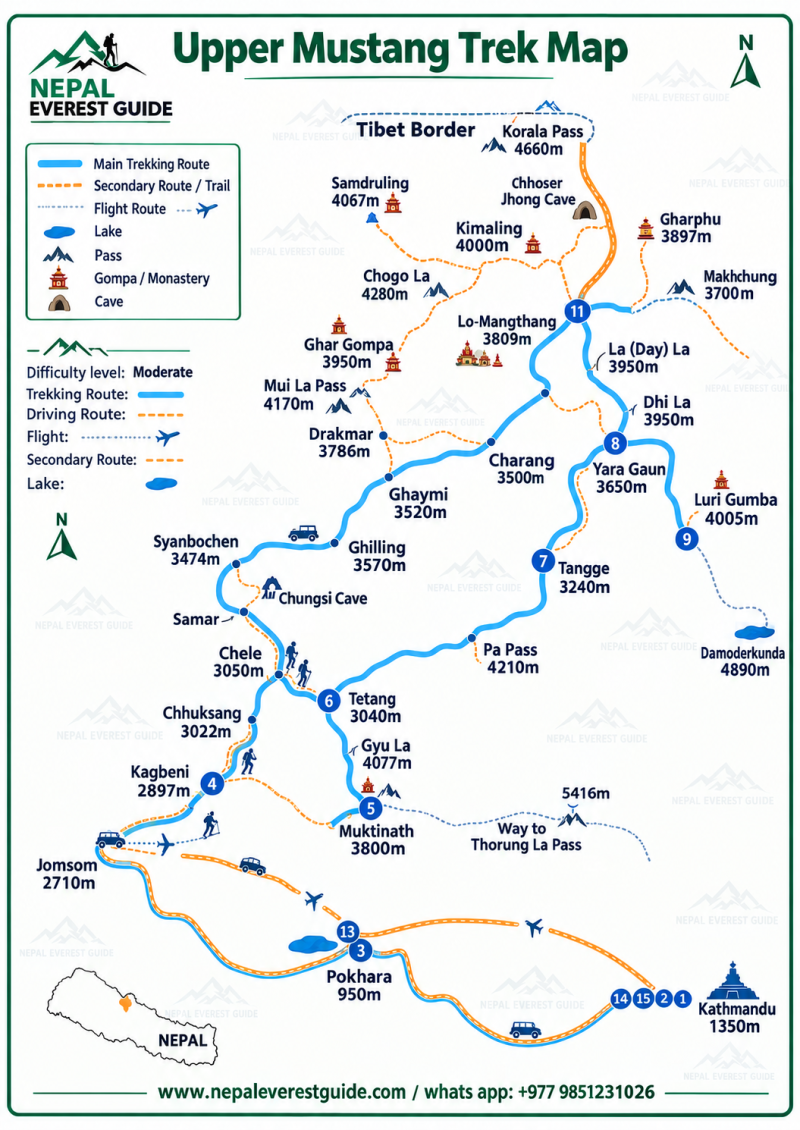
Day 1: Pokhara → Jomsom → Kagbeni (2,810 m) — Drive from Pokhara to Jomsom and continue to Kagbeni, approx. 160 km by road | 8–10 hrs.
Day 2: Kagbeni → Chele (3,050 m) — Enter Upper Mustang and trek through Tangbe and Chhusang, 14 km | 5–6 hrs.
Day 3: Chele → Syangboche (3,475 m) — Cross Taklam La and Dajori La passes via Samar, 12 km | 6–7 hrs.
Day 4: Syangboche → Ghami (3,520 m) — Cross Nyi La Pass and descend through dramatic mountain scenery, 11 km | 5–6 hrs.
Day 5: Ghami → Tsarang (3,560 m) — Trek through dry valleys, colorful cliffs, and ancient Buddhist sites, 10–11 km | 4–5 hrs.
Day 6: Tsarang → Lo Manthang (3,840 m) — Cross the high Mustang plateau and reach the historic walled city, 11–12 km | 4–5 hrs.
Day 7: Explore Lo Manthang (3,840 m) — Visit ancient monasteries, traditional villages, the former royal palace, and nearby cultural sites, 3–5 hrs walking and sightseeing.
Day 8: Lo Manthang → Dhakmar (3,800 m) — Begin the return trek through the spectacular high-altitude landscape, 16–18 km | 6–7 hrs.
Day 9: Dhakmar → Ghiling (3,806 m) — Trek through remote valleys and striking red-rock landscapes, 14–16 km | 5–6 hrs.
Day 10: Ghiling → Chhusang (3,050 m) — Descend through Samar and traditional Mustang villages, 17–19 km | 6–7 hrs.
Day 11: Chhusang → Jomsom (2,720 m) — Follow the Kali Gandaki Valley back to Jomsom, 16–18 km | 5–6 hrs.
Day 12: Jomsom → Pokhara — Drive back to Pokhara through the scenic Kali Gandaki Valley, approx. 150 km by road | 7–9 hrs.
What's included?
- Airport to Hotel picks up and drops by private car or van it depends on the size of the group,
- 2 nights hotel in Kathmandu and 2-night hotel in Pokhara on BB plan,
- All local transportation,
- An expert tour guide for Kathmandu valley sightseeing,
- Meals (Breakfast/Lunch/Dinner) and all accommodations during the trekking,
- A highly experienced well-trained government license holder guide and porters (one porter between two trekkers),
- Annapurna Conservation Area Project permit and TIMs (Trekkers information management system) card,
- All government taxes and local taxes,
- Guide and porter salary, insurance, transportation,
- flight ticket to Jomsom Pokhara both way.
What's not included?
- Lunch and dinner in Kathmandu and Pokhara,
- Travel insurance,
- Nepal entry visa fee, which is easily issued upon your arrival at Tribhuwan international airport at Kathmandu,
- Your personal expressions such as bar bills, alcoholic and non-alcoholic drinks,
- All kind of drinks (Water/Coke/alcoholic beverage and hot drinks),
- Tip for field staff (guide, poster and driver)after the success of your trip, it is expected.
Day by Day Itinerary
DAY
01
Drive from Pokhara to Jomsom and Continue to Kagbeni
8-9 Hrs Drive (153km) Lodge
Your Upper Mustang adventure begins with a scenic drive from Pokhara toward Jomsom, following the Kali Gandaki Valley through beautiful mountain scenery. The road passes waterfalls, traditional villages, terraced hillsides, and dramatic river valleys before reaching Jomsom. After a short break, continue toward Kagbeni, an ancient settlement located at the entrance to Upper Mustang. Kagbeni is known for its narrow lanes, traditional houses, Buddhist culture, and impressive views of the surrounding mountains. Spend the evening exploring the historic village and preparing for the trek ahead.
DAY
02
Trek from Kagbeni to Chele
3-4 Hrs ( 14 km) Breakfast, Lunch & Dinner Lodge
After breakfast, begin trekking north from Kagbeni and enter the restricted Upper Mustang region. The trail follows the Kali Gandaki Valley through an increasingly dry and dramatic landscape. Along the way, pass through Tangbe, a traditional village surrounded by barley fields, apple orchards, and striking red cliffs. Continue toward Chhusang, where several caves and unusual rock formations can be seen above the valley. The trail then climbs gradually to Chele, a small mountain settlement with traditional houses and spectacular views across the barren Mustang landscape. Overnight in Chele.
DAY
03
Trek from Chele to Syangboche( 3,475 m)
7 Hrs (12 km) Breakfast, Lunch & Dinner Lodge
Today brings one of the more demanding sections of the trek. From Chele, the trail climbs steadily through dry, rugged terrain before crossing the high mountain passes of Taklam La and Dajori La. Along the way, you enjoy wide views across the surrounding valleys and striking colorful cliffs.
After crossing the passes, the trail descends toward Samar, a traditional Mustang village surrounded by barren hills and dramatic landscapes. The peaceful village provides a welcome change after the morning's challenging climbs.
From Samar, the route continues through narrow valleys and past distinctive rock formations before reaching Syangboche. The changing scenery, from high passes and dry cliffs to hidden valleys and traditional settlements, makes this a rewarding day on the Upper Mustang Trek.
DAY
04
Trek from Syangboche to Ghami (3,520 m)
5-6 Hrs Trek & 11 km Breakfast, Lunch & Dinner Lodge
After breakfast in Syangboche, continue deeper into the remote landscapes of the Upper Mustang Trek. The trail gradually climbs through dry, rugged terrain toward Nyi La Pass, one of the notable high points on this section of the journey. As you gain elevation, the views open across the dramatic valleys and barren hills of Mustang.
Crossing Nyi La Pass, the trail descends into a spectacular valley surrounded by weathered cliffs, rocky slopes, and striking layers of natural colors. The landscape becomes increasingly arid, with sparse vegetation highlighting the unique high-desert environment that makes Upper Mustang so distinctive.
The trek eventually reaches Ghami, one of the largest traditional villages in Upper Mustang. Here, you can explore the village’s Buddhist heritage, including its impressive mani wall and surrounding religious monuments. Ghami offers a fascinating glimpse into the centuries-old Tibetan-influenced culture and spiritual traditions of the region.
DAY
05
Kagbeni to Chele (3050m)
10–11 km | Trekking: 4–5 hours Breakfast, Lunch & Dinner Lodge
Today is a relatively shorter and enjoyable section of the Upper Mustang Trek, giving you more time to appreciate the unique landscapes and cultural heritage. Leave Ghami and cross the Ghami Khola before following the trail through dry valleys, rocky terrain, and impressive natural formations. Colorful cliffs shaped by centuries of wind and erosion create a striking backdrop along the route.
The trail gradually leads toward Tsarang, passing traditional settlements, Buddhist structures, and cultivated fields that contrast beautifully with the surrounding barren hills. Upon arrival, take time to explore this historic village, admire its traditional architecture, and experience the peaceful atmosphere before spending the night in Tsarang.
DAY
06
Chele to Syanbochen (3,475 m)
11–12 km | Trekking: 4–5 hours Breakfast, Lunch & Dinner Lodge
Today is one of the major highlights of the Upper Mustang Trek as you leave Tsarang and continue toward Lo Manthang, the historic walled capital of the Mustang region. The trail gradually climbs across the open, high-altitude plateau, with spectacular views of barren hills, broad valleys, and distant snow-capped mountains.
As the trail progresses, the landscape becomes increasingly vast and dramatic. After several hours of trekking, the distinctive walls of Lo Manthang gradually appear ahead, marking your arrival at one of Nepal’s most fascinating Himalayan settlements.
Enter the historic town and settle into your accommodation before taking time to explore the surroundings. In the evening, wander through the narrow lanes and admire the traditional whitewashed houses, ancient architecture, and unique atmosphere that make Lo Manthang a memorable highlight of the Upper Mustang Trek.
DAY
07
Explore Lo Manthang and Chhoser
3–5 hours Breakfast, Lunch & Dinner Lodge
Today is dedicated to exploring the cultural and historical heart of the Upper Mustang Trek. Take time to discover Lo Manthang, the famous walled town known for its traditional houses, ancient Buddhist monasteries, and distinctive Tibetan-influenced architecture. Visiting the important religious sites offers a closer look at the traditions and way of life that have shaped this remote Himalayan region for centuries.
You can also take an excursion toward Chhoser, where remarkable caves and ancient cliffside settlements reveal fascinating stories of Mustang’s past. The combination of dramatic landscapes and centuries-old cultural heritage makes this an especially memorable day.
The relaxed pace also gives you valuable time to rest and acclimatize to the altitude before beginning the return journey. Enjoy the peaceful atmosphere of Lo Manthang and prepare for the next stage of your Upper Mustang Trek.
DAY
08
Trek from Lo Manthang to Dhakmar ( 3,800m)
5 Hrs ( 17 km) Breakfast, Lunch & Dinner Lodge
After breakfast, leave Lo Manthang and begin the return trek toward the southern part of Upper Mustang. The trail crosses open valleys and rugged mountain terrain, offering a different perspective of the landscape you experienced on the way north.
The route passes through remote areas where the combination of barren cliffs, high plateaus, and traditional settlements creates an extraordinary Himalayan setting. Continue toward Dhakmar, a distinctive village surrounded by dramatic red cliffs. After a longer day on the trail, settle into your teahouse and enjoy a relaxing evening in this remote mountain community.
DAY
09
Trek from Dhakmar to Ghiling ( 3,806m)
14–16 km | Trekking: 5–6 hours Breakfast, Lunch & Dinner Lodge
Continue south from Dhakmar and follow the trail deeper through the rugged landscapes of the Upper Mustang Trek. The route winds through dry valleys and rocky hills, with occasional views of traditional villages, Buddhist monuments, and striking mountain scenery. Colorful cliffs and wide-open slopes make the journey visually rewarding.
As you walk, you will experience the unique character of Mustang’s high-altitude environment, where isolated communities have adapted to the dry climate and challenging terrain. The changing landscape provides plenty of opportunities to appreciate the region’s natural beauty and traditional way of life.
After several hours of trekking, arrive at Ghiling, a traditional village surrounded by barren mountains and cultivated fields. Enjoy a peaceful evening, relax after the walk, and take in the quiet atmosphere before continuing the descent the following day.
DAY
10
Trek from Ghiling to Chhusang (3,050 m)
17–19 km | Trekking: 6–7 Breakfast, Lunch & Dinner Lodge
After breakfast in Ghiling (3,570 m), begin the return journey toward the lower valleys of Mustang. Today is mainly a descending section of the Upper Mustang Trek, taking you through the remote villages and dramatic high-desert landscapes you experienced earlier from a different perspective. The trail passes through Syangboche, then continues toward Samar (approximately 3,660 m), a beautiful traditional village surrounded by dry hills and small green areas created by local irrigation.
From Samar, the trail continues toward Chele (3,050 m), following winding paths through rocky valleys and weathered cliffs. Depending on the route and trekking conditions, there may be short ascents and descents along the way, including sections around the high ridges above Samar. The changing scenery is one of the highlights of the day, as the barren landscape gradually becomes more sheltered and vegetation begins to appear along the lower valleys.
From Chele, continue descending through the dramatic Kali Gandaki valley toward Chhusang (3,050 m). The trail passes through the distinctive Mustang landscape of red and orange cliffs, rocky gorges, traditional settlements, and ancient cave formations. As you approach Chhusang, the valley becomes greener, with fields and trees appearing around the riverbanks. Arrive at Chhusang, a picturesque village beneath towering cliffs, and enjoy a relaxing evening after this rewarding descent.
DAY
11
Trek from Chhusang to Jomsom (2720m)
16–18 km | Trekking: 5–6 hours Breakfast, Lunch & Dinner Lodge
Your final trekking day follows the Kali Gandaki Valley toward Jomsom. The trail gradually descends through traditional Mustang settlements and increasingly green landscapes as you move to lower elevations. Along the way, enjoy views of the surrounding Himalayan peaks and the dramatic river valley. The familiar scenery marks the transition from the remote Upper Mustang region back toward lower Mustang. Arrive in Jomsom, the administrative center of Mustang, and check into your accommodation. After completing the trekking section, you can relax, enjoy a warm meal, and reflect on the remarkable journey through Upper Mustang.
DAY
12
Drive from Jomsom to Pokhara (850m)
7-8 Hrs Drive Breakfast, Lunch & Dinner Lodge
After breakfast, begin the scenic drive from Jomsom back to Pokhara. The road follows the Kali Gandaki Valley, passing through mountain villages, waterfalls, rugged cliffs, and changing landscapes as you descend. The scenery gradually transforms from the dry trans-Himalayan environment of Mustang into greener hills and river valleys. Depending on road conditions and stops along the way, the journey takes most of the day. Arrive in Pokhara in the afternoon or evening, marking the end of your 12-day Upper Mustang Trek.
Departure Dates
| Starts On | Ends On | Price (USD) | Availability | Booking |
|---|
"Attention Trekkers! Experience a safe and thrilling holiday adventure with us this Spring and Autumn 2023. Enjoy a 15% discount on bookings. Don't miss out on this amazing offer. Book now!"
Essential Information
When is best time to go on Upper Mustang trekking?
The best time for the Upper Mustang Trek is generally spring (March to May) and autumn (September to November). During these seasons, the weather is usually favorable for trekking, with comfortable daytime temperatures, relatively stable conditions, and good mountain visibility. May is particularly interesting for cultural travelers because the Tiji Festival is celebrated in Lo Manthang during this period.
One of the unique advantages of Upper Mustang is that it lies in the rain shadow of the Annapurna and Dhaulagiri mountain ranges. Unlike many popular trekking areas of Nepal, Upper Mustang receives relatively little monsoon rainfall, making June to August a suitable period for trekking as well. The dry landscape, ancient villages, caves, and dramatic cliffs can be explored even during Nepal's rainy season, although weather can still affect transportation to and from the region.
Spring (March–May) offers warmer days and pleasant trekking conditions, while autumn (September–November) is favored for generally clear skies and excellent Himalayan views. Winter (December–February) is much colder, and snow and freezing temperatures can make high-altitude trekking more challenging, particularly around the mountain passes and remote settlements.
Overall, spring and autumn are the best seasons for a comfortable Upper Mustang Trek, while the monsoon season is an excellent alternative for travelers who want to explore a drier Himalayan region during summer. If experiencing local culture and festivals is a priority, consider planning your trek around the Tiji Festival in Lo
Accommodation Options and Facilities During the Upper Mustang Trek:
Upper Mustang Trek accommodation mainly includes local tea houses, guesthouses, and mountain lodges. Rooms are usually simple and comfortable, with beds, mattresses, blankets, and pillows. Bathrooms may be shared or private depending on the lodge.
Meals commonly include Dal Bhat, noodles, fried rice, pasta, momos, and other local dishes. Electricity and hot showers are available in many villages, although facilities can vary and may cost extra. A sleeping bag is recommended for extra warmth, especially at higher elevations and during colder months.
What to take with you for the trek:
Here is a list of essential items to bring on the Upper Mustang Trek:
- Backpack: A comfortable and spacious backpack to carry your belongings during the trek.
- Clothing: Warm layers, such as a fleece or down jacket, a hat, gloves, and waterproof/windproof outerwear.
- Footwear: Comfortable and sturdy hiking boots or shoes, as well as lightweight and quick-drying socks.
- Hydration: A water bottle or hydration system and water purification tablets.
- First-aid kit: Basic medical supplies such as pain relievers, bandages, and blister treatment.
- Personal hygiene items: Toothbrush, toothpaste, wet wipes, and hand sanitizer.
- Sun protection: Sunscreen, sunglasses, and a wide-brimmed hat.
- Headlamp or torch: For navigating in the dark.
- Camera: To capture the stunning scenery and unique culture of the region.
- Cash: ATMs are not readily available in Upper Mustang, so it's important to bring enough cash for the trek.
Permit for the upper mustang trek:
The permit fee for the Upper Mustang Trek for Westerners (non-SARCC nationals) was $500 for the first 10 days and an additional $50 per day after that. For citizens of South Asian Regional Cooperation Council (SARCC) countries, the permit fee was $50 for the first 10 days and an additional $5 per day after that. It's important to note that these fees are subject to change, and it's always best to check with a registered trekking agency or the Nepal Tourism Board for the most up-to
Reaching upper mustang trek:
Upper Mustang Trek is located in the northern part of Nepal, in the Mustang district. It lies in the rain shadow of the Himalayas and is known for its arid desert-like landscape, unique culture, and historical significance. To reach Upper Mustang, one needs to fly to Pokhara and then take a short flight to Jomsom. From Jomsom, the trek begins and continues through remote villages, stunning valleys, and ancient monasteries until reaching the former kingdom of Lo Manthang. The trek to Upper Mustang requires a special permit, which can be obtained through a registered trekking agency in Nepal.
Mustang Mustang trek Difficult:
The Upper Mustang Trek is considered a moderate to difficult trek due to its high altitude and rugged terrain. Trekkers must be physically fit and have some prior trekking experience. The trail follows a steep and rocky terrain with several uphill and downhill climbs. The altitude can also pose a challenge, with the trek reaching heights of over 4000 meters. However, with proper acclimatization and a good level of fitness, most trekkers should be able to complete this stunning trek and enjoy the unique beauty of the Mustang region.
Hiring a Guide for the Upper Mustang Trek:
Yes, a guide is required for the Upper Mustang Trek. The Mustang region is a restricted area and requires a special permit to enter. As per the regulations, all trekkers must be accompanied by a licensed guide or a porter. Having a guide not only ensures your safety but also enhances your trekking experience as they can provide valuable insights into the local culture, history, and geography of the region. They can also assist with logistics, accommodations, and navigation on the trail. Therefore, it is highly recommended to hire a guide from a reputable trekking agency for the Upper Mustang Trek.
Accommodation during the upper mustang trek:
Accommodation during the Upper Mustang Trek is generally in teahouses or lodges along the trail. These teahouses are basic but comfortable, offering a bed, blankets, and sometimes hot showers for an additional fee. In some places, you may need to share a room with other trekkers or locals. The teahouses also have dining areas where you can enjoy meals such as dal bhat (rice, lentils, and vegetables), noodles, soups, and other local dishes. In the Upper Mustang region, the availability of teahouses and lodges is limited, so it's important to plan your trek and book your accommodation in advance, especially during peak trekking seasons.
Available food during Upper Mustang trek:
During the Upper Mustang trek, you can find a variety of food options, including local Nepali dishes and some international cuisines. Dal bhat is a popular staple food, which consists of rice, lentils, vegetables, and sometimes meat. You can also find noodles, soups, momos (steamed dumplings), and thukpa (Tibetan noodle soup) in teahouses along the trail. In addition, some teahouses serve pizza, pasta, and other western dishes. Snacks such as biscuits, chocolates, and energy bars are also available, and it's recommended to carry some of your favorite snacks for the trek. It's important to stay hydrated during the trek, so drink plenty of water or tea, which are readily available in the teahouses.
Altitude sickness During Upper Mustang Trek:
Altitude sickness, also known as acute mountain sickness (AMS), can occur during the Upper Mustang Trek due to the high altitude of the region. Symptoms of AMS include headache, nausea, dizziness, and shortness of breath. To prevent AMS, it's important to acclimatize properly by taking rest days, staying hydrated, and avoiding alcohol and smoking. If symptoms persist or worsen, descending to a lower altitude is necessary. It's recommended to consult with a licensed trekking guide or a medical professional for further advice.
Upper mustang trek FAQs: Frequently asked questions
What is the best time to do the Upper Mustang Trek?
Answer: The best time to do the Upper Mustang Trek is during the Spring (March to May) and Autumn (September to November) seasons when the weather is dry and clear, and the temperature is moderate.
Do I need a special permit for the Upper Mustang Trek?
Answer: Yes, a special permit called the "Restricted Area Permit" is required for the Upper Mustang Trek, which costs USD 500 for the first ten days and USD 50 per day thereafter.
How difficult is the Upper Mustang Trek?
Answer: The Upper Mustang Trek is considered a moderate to difficult trek due to its high altitude, rugged terrain, and some steep ascents and descents. Trekkers must be physically fit and have some prior trekking experience.
What is the duration of the Upper Mustang Trek?
Answer: The duration of the Upper Mustang Trek can vary from 10 to 18 days depending on the itinerary and the trekking route.
What is the maximum altitude reached during the Upper Mustang Trek?
Answer: The maximum altitude reached during the Upper Mustang Trek is 3,800 meters at the Lo La Pass.
Are there any age restrictions for the Upper Mustang Trek?
Answer: There are no specific age restrictions for the Upper Mustang Trek, but trekkers should be in good health and have some prior trekking experience.
Is it possible to do the Upper Mustang Trek independently?
Answer: No, it is not possible to do the Upper Mustang Trek independently as it is a restricted area and requires a licensed guide or a porter.
What type of accommodation is available during the Upper Mustang Trek?
Answer: Accommodation during the Upper Mustang Trek is in teahouses or lodges along the trail, which are basic but comfortable.
What is the food like during the Upper Mustang Trek?
Answer: The food during the Upper Mustang Trek consists of local Nepali dishes such as Dal-Bhat, noodles, soups, Momos, and Thukpa, as well as some international cuisines such as pizza and pasta.
What is the weather like during the Upper Mustang Trek?
Answer: The weather during the Upper Mustang Trek is generally dry and clear during the Spring and Autumn seasons, but it can get cold at night and in higher elevations.
Is it safe to drink water during the Upper Mustang Trek?
Answer: It is not safe to drink tap water during the Upper Mustang Trek. It is recommended to drink boiled or filtered water or use water purification tablets.
Are there any cultural sites to visit during the Upper Mustang Trek?
Answer: Yes, there are many cultural sites to visit during the Upper Mustang Trek, including ancient monasteries, temples, and traditional villages.
What kind of equipment do I need for the Upper Mustang Trek?
Answer: You will need warm clothing, sturdy hiking boots, a backpack, a sleeping bag, a first aid kit, and other essential trekking gear.
How do I prepare for the Upper Mustang Trek?
Answer: You should start preparing for the Upper Mustang Trek by doing some physical exercise, getting a medical check-up, and getting acclimatized to the altitude before the trek.
How can I book the Upper Mustang Trek?
Answer: You can book the Upper Mustang Trek through a reputable trekking agency in Nepal or through online travel booking platforms.
Cancellation Note
- Free cancellation up to 60 days prior departure
- 30% of the total cost of the trip will be charged if cancelled between 60 to 30 days prior to departure date
- 60% of total cost of the trip will be charged if cancelled in between 30 to 14 days prior to departure date.
Web design & Developed by Wildstone Solution
