

KATHMANDU - SABRUBESI -LAMA HOTEL - MUNDU - LANGTANG - kYANJIN GOMPA - kYANJIN-RI - LAMA HOTEL - KATHMANDU



Why Langtang Valley Trek with a Local Guide?
- Scenic Drive: Enjoy a beautiful drive from Kathmandu to Syabrubesi, through lush landscapes and rural areas.
- Tamang Villages: Experience the culture and hospitality of Tamang villages like Langtang and Mundu.
- Diverse Landscapes: Trek through forests, rivers, and alpine meadows with stunning mountain views.
- Langtang National Park: Explore this park, home to diverse wildlife like red pandas and Himalayan tahrs.
- Kyanjin Gompa: Visit this monastery for a serene atmosphere and panoramic mountain views.
- Tserko Ri: Hike to Tserko Ri for breathtaking views of the Langtang range from 5,000 meters (16,404 feet).
- Buddhist Monasteries: Discover traditional monasteries and chortens along the trek.
- Mani Walls: Walk past mani walls, which are inscribed with religious mantras.
- Mountain Views: Enjoy views of Langtang Lirung, Ganesh Himal, and other peaks.
- Rich Culture: Learn about the Tamang people's culture and traditions.
- Less Crowded: Experience a more peaceful trek compared to other popular routes
Langtang Valley Trek with a Local Guide Introduction:
Who Is the Langtang Valley Trek Suitable For?
Why Choose a Langtang Valley Trek with a Local Guide?
- More Experience: Independent guides often have more personal experience and local knowledge of the Langtang region compared to guides from larger agencies.
- Cost-Effective: Independent guides generally offer more affordable rates, helping you save money on your trek.
- Support for Local Communities: By hiring an independent guide, you directly contribute to the livelihoods of local village people, supporting their economic development.
- Personalized Attention: Independent guides can offer a more personalized and flexible trekking experience, tailored to your specific needs and preferences.
- Authentic Experience: You get a more genuine cultural experience as independent guides often have deeper connections with local communities and can provide more insightful interactions.
- Widespread Coverage: Independent guides are usually well-traveled and knowledgeable about trekking routes across Nepal, not just in Langtang Valley.
- Direct Communication: You have direct and straightforward communication with your guide, which can lead to a smoother and more organized trekking experience.
- Customized Itinerary: Independent guides can adjust the itinerary based on your interests and pace, offering a more customized trekking experience.
- Encouragement of Sustainable Tourism: Supporting independent guides promotes responsible and sustainable tourism practices, benefiting the environment and local cultures.
- Closer Relationship: With an independent guide, you build a closer, more personal relationship, which can enhance your overall trekking experience and provide valuable local insights.
Langtang Valley Trek with a Local Guide Outline
Day 01: Drive from Kathmandu to Syabrubesi 1,550 m/5,100 ft (1.55 km): 7-8 hrs,
Day 02: Syabrubesi to Lama Hotel 2,380 m/7,830 ft (2.39 km): 6 hours,
Day 03: Lama Hotel to Mundu 3,543 m/11,621 ft (3.54 km) via Langtang village: 6-7 hrs,
Day 04: Mundu to Kyangjin Gompa 3,870 m/12,697 ft (ca. 4 km): 4-5 hrs, Day 07: Acclimatization- Explore Tserko Ri 5,000 m/16,404 ft (ca. 5 km) :7-8 hrs,
Day 05: Acclimatization- Explore Tserko Ri (5,000 m/16,404 ft)(ca. 5 Km)
Day 06: Kyangjin Gompa to Lama Hotel: 6-7 hrs,
Day 07: Lama Hotel to Syabrubesi: 4-5 hrs,
Day 08: Syabrubesi to Kathmandu,
What's included?
- Round-Trip Local Bus Transportation: Comfortable local bus tickets from Kathmandu to Syabrubesi and back to Kathmandu are included.
- Experienced Langtang Trek Guide: Trek with a friendly, government-licensed local guide who has extensive knowledge of the Langtang region, mountain trails, local culture, and trekking safety.
- Three Daily Meals: Enjoy breakfast, lunch, and dinner throughout the trek. Each meal includes one main course served at local tea houses.
- Professional Guide and Porter Service: A highly experienced, government-licensed trekking guide and one porter for every two trekkers are provided. Their salary, meals, accommodation, insurance, and trekking equipment are fully covered.
- Langtang National Park Entry Permit: All required Langtang National Park entrance fees are included in the package.
- TIMS Card: The required Trekkers' Information Management System (TIMS) Card is arranged before your trek.
- Guide's Expenses Covered: Your guide's salary, food, accommodation, transportation, insurance, and other trekking expenses are fully included.
- Tea House Accommodation: Comfortable accommodation in local mountain tea houses is provided throughout the trek on a twin-sharing basis.
- Government Taxes and Service Charges: All applicable government taxes, local service charges, and administrative fees are included with no hidden costs.
What's not included?
NOTE: If your group has more than 5 people, you'll receive a discount. For groups of more than 10, the person who organizes the group will enjoy a 50% discount. And for groups larger than 15, one person will get the trek completely free.
Day by Day Itinerary
DAY
01
Drive from Kathmandu to Syabrubesi (1,550 m/5,100 ft)
7-8 hrs (122km) Breakfast, Lunch & Dinner Lodge
We start early from Kathmandu by bus or private jeep on request. The scenic drive takes around 7–9 hours, passing through Trishuli, Betrawati, Kalikasthan, Ramche and Dhunche. Along the way, you will enjoy views of the Trishuli River, green hills, terraced fields, villages and waterfalls.
We stop for lunch at a suitable local restaurant along the route and continue toward Dhunche, an important gateway for the Langtang Valley, Gosaikunda and Tamang Heritage routes. As we climb higher, the landscape becomes more mountainous, and on a clear day you may see parts of the Ganesh Himal and Langtang ranges.
Finally, we reach Syabrubesi, the main gateway to Langtang Valley. The mountain road can be rough and winding, so we take our time and enjoy the journey. Upon arrival, we check into our lodge, relax and prepare for tomorrow’s trek.
DAY
02
Syabrubesi to Lama Hotel (2,380 m/7,830 ft)(2.39 Km): 6 hours
6 Hrs Walk (11.5 km) Breakfast, Lunch & Dinner Lodge
After breakfast, we begin our first walking day of the Langtang Valley Trek, following the Langtang Khola through peaceful forest. The trail passes Domen and Pahiro before reaching the riverside settlement of Bamboo. The first section is mostly gradual, with suspension bridges, waterfalls and beautiful views of the surrounding hills.
At Bamboo, we stop for lunch at one of the local teahouses. After a good rest and a warm meal, the trail becomes steeper as we walk through dense bamboo, oak and rhododendron forests. We cross more bridges and continue climbing steadily beside the river.
We then reach Rimche, a very small settlement with only a few basic teahouses. It is possible to stay here if needed, but most trekkers continue toward Lama Hotel. From Rimche, expect another steady uphill section before the trail finally brings us to Lama Hotel.
Lama Hotel is a small mountain settlement with simple lodges and friendly local hosts. The rooms and dining areas are basic, but you can order fresh meals from the menu, enjoy tea or coffee, and relax in the peaceful forest surroundings. We spend the night here and prepare for tomorrow's trek deeper into the Langtang Valley.
DAY
03
Lama Hotel to Mundu (3543 m/11,621 ft)(3.54 Km) via Langtang village
6-7 hrs Walk ( 14 km) Breakfast, Lunch & Dinner Tea House
We begin early with a warm breakfast at Lama Hotel and continue deeper into the Langtang Valley. The trail climbs steadily through a beautiful alpine forest of tall pine, fir and rhododendron trees. As we gain altitude, the forest gradually opens and you begin to catch your first impressive views of snow-covered Himalayan peaks. After around 2–3 hours, we reach Ghoda Tabela, a peaceful mountain stop where we take a well-deserved break and enjoy lunch at a local teahouse.
After lunch, the landscape changes noticeably. The dense forest gives way to a wide, open valley, with the Langtang Khola flowing below and waterfalls descending from the surrounding mountains. The trail is more gradual here, making the walk enjoyable as we pass stone walls, prayer flags, small Buddhist shrines and traditional mountain settlements.
We continue toward Langtang Village, an important cultural and scenic point on the trek. The surrounding mountains become increasingly dramatic, and the open landscape gives us a much clearer view of the high Himalayan peaks. We take time to enjoy the village atmosphere before continuing along the valley toward Mundu.
A short and pleasant walk beyond Langtang Village brings us to Mundu, our destination for the night. Here, we settle into a simple local lodge, enjoy a freshly prepared dinner and relax in the quiet mountain surroundings. Tonight we sleep at a higher altitude, surrounded by the spectacular Langtang Himalayas, ready for tomorrow's journey toward Kyanjin Gompa.
DAY
04
Mundu to Kyangjin Gompa (3,870 m/12,697 ft)
4-5 hrs Walk (7 km) Breakfast, Lunch & Dinner Lodge
Today, we continue the Langtang Valley Trek from Mundu to Kyanjin Gompa, one of the most memorable sections of the journey. After breakfast, we begin a short and gradual walk toward Kyanjin Gompa, surrounded by peaceful Himalayan scenery and increasingly impressive mountain views. Since the distance is only around 4 km, there is plenty of time to walk at a comfortable pace and enjoy the beautiful surroundings.
As we move higher into the valley, the trail takes us through a fascinating Buddhist landscape. Along the way, we pass colorful prayer flags, traditional chortens, stone mani walls, and water-powered prayer wheels. The peaceful atmosphere and ancient Buddhist traditions make this section more than just a mountain walk. It offers a wonderful opportunity to experience the spiritual side of the Langtang region.
After reaching Kyanjin Gompa at 3,870 meters, we settle into our lodge and take some time to explore the village. Kyanjin Gompa is an important Buddhist settlement in the upper Langtang Valley and is surrounded by spectacular Himalayan peaks. Instead of spending the whole afternoon indoors, we recommend a gentle walk around the village to enjoy the mountain scenery, visit the monastery area, and become familiar with this remarkable high-altitude environment.
Kyanjin Gompa is one of the major highlights of the Langtang Valley Trek, and arriving here marks a rewarding moment in the journey. The combination of dramatic mountains, Buddhist culture, traditional villages, and peaceful Himalayan surroundings makes today's short trek particularly special.
DAY
05
Acclimatization- Explore Tserko Ri (5,000 m/16,404 ft)(ca. 5 Km)
6 Hrs Walk Breakfast, Lunch & Dinner Lodge
Today is one of the most pleasant and memorable days of the Langtang Valley Trek. We spend the night at Kyanjin Gompa and take time to explore this beautiful Himalayan village while allowing our bodies to adjust to the higher altitude. Kyanjin is a peaceful, colorful, and open mountain settlement surrounded by snow-capped peaks, with small cafés, lodges, hotels, and local shops where you can relax and enjoy the incredible Himalayan atmosphere.
If the weather is clear and you feel comfortable with the altitude, we start early in the morning for a hike toward Tserko Ri, reaching approximately 5,000 meters. The early morning is usually the best time for mountain views, as the skies are often clearer before clouds develop later in the day. From the viewpoint, you can enjoy breathtaking views of the Langtang mountain range, glaciers, surrounding valleys, and towering snow-covered peaks. After enjoying the scenery and taking photographs, we return to Kyanjin Gompa for a well-deserved rest.
Back in the village, there is plenty of time to enjoy Kyanjin at a relaxed pace. You can sit at a local café with a cup of hot coffee while looking directly toward the snow-capped mountains. A visit to the Yak Cheese Factory is another enjoyable experience, where you can learn about traditional yak cheese production and taste authentic local cheese.
For those who prefer a shorter and easier acclimatization walk, the area around Kyanjin offers several beautiful trails and viewpoints. You can explore the open valley, walk around the village, visit the monastery area, or simply find a peaceful spot to enjoy the mountain scenery. Kyanjin is surprisingly spacious, giving trekkers plenty of opportunities to explore without feeling rushed.
The combination of mountain views, Tibetan Buddhist culture, local cafés, yak cheese, peaceful trails, and fresh Himalayan air makes this an especially enjoyable day of the Langtang trek. Whether you choose to challenge yourself with Tserko Ri or spend the day exploring Kyanjin village at a slower pace, this acclimatization day gives you time to appreciate the beauty of the upper Langtang Valley before continuing your journey.
DAY
06
Kyangjin Gompa to Lama Hotel
6-7 Hrs Walk Breakfast, Lunch & Dinner Lodge
After spending a wonderful time at Kyanjin Gompa, we leave the village around 7:00 AM after breakfast and begin our return journey to Lama Hotel. Today, we follow the same trail back through the beautiful Langtang Valley, but the downhill walk is easier and more relaxed.
We pass through the familiar small villages, Buddhist chortens, mani walls, yak pastures, pine forests, and mountain streams. As we gradually lose altitude, the landscape becomes greener and warmer. After enjoying the scenic trail and taking a few breaks along the way, we reach Lama Hotel, where we have a warm meal, relax, and spend the night at the lodge.
DAY
07
Lama Hotel to Syabrubesi
4-5 Hrs Walk Breakfast, Lunch & Dinner Hotel
After breakfast at Lama Hotel, we begin our final walk of the Langtang Valley Trek toward Syabrubesi. The trail gradually descends through peaceful pine and rhododendron forests, following the familiar Langtang River and passing small mountain settlements along the way.
As we continue downhill, the trail becomes warmer and greener, with beautiful views of the surrounding hills and valley. We take our time to enjoy the peaceful forest, local villages, and fresh mountain air before reaching Syabrubesi, the starting point of our trek.
After arriving in Syabrubesi, we can relax, enjoy a good meal, and celebrate the completion of our memorable Langtang Valley Trek.
DAY
08
Drive from Syabrubesi to Kathmandu
7 hrs Drive Breakfast, Lunch & Dinner Hotel
After an early breakfast, we take a bus from Syabrubesi to Kathmandu, marking the final journey of our Langtang Valley Trek. We follow the same scenic road back through the hills, but the journey offers a different perspective of the Langtang Valley, rivers, villages, and dramatic mountain landscapes.
After arriving in Kathmandu, you can relax at your hotel or enjoy some free time exploring the city and shopping for souvenirs. Popular Nepalese souvenirs include woolen products, mountain-themed T-shirts and cups, traditional artwork, wooden masks, Buddha and Hindu deity statues, and other locally made handicrafts.
This scenic drive brings our Langtang Valley Trek to a comfortable end, leaving you with wonderful memories of the mountains, villages, and culture of Nepal.
Departure Dates
Sorry, No fixed departure dates are listed to group join, please request private trip
Discover the Hidden Gem of Langtang Valley!
Join our 6-7-day Langtang trek through lush forests, traditional villages, and breathtaking mountain views. Immerse yourself in Tamang culture, explore ancient monasteries, and trek to stunning viewpoints, just a short drive from Kathmandu!
Ready to trek? Contact Santosh today!
Email: nepaleverestguide@gmail.com
WhatsApp: +977 9849116284
Reviews
Marco Trevisol
Egypt
Our Team From Egypt got best trip in Nepal- Safe Holiday Adventure Team
September, 2022My cousins and I recently embarked on an unforgettable Langtang trek in Nepal, and we had an incredible time. The trip was expertly planned from start to finish, and we were able to experience all the beauty that Nepal has to offer. From the stunning landscapes to the warm hospitality of the locals, every moment of our journey was a true delight.
I am so grateful for the meticulous planning that went into our trek, and I would highly recommend this adventure to anyone who loves to explore new cultures and breathtaking landscapes. The memories we made during our trip will stay with us forever, and we are already looking forward to our next adventure in Nepal.
Thank you to all the staff at the trekking company for their hard work and dedication to ensuring our trip was a success. We appreciate all that you did to make our Langtang trek a truly unforgettable experience. Sincerely, Marco Trevisol, Egypt.
Danielle Chang
Egypt
Lyki baster
2020The previous week I do an ABC trek with my cousins. We all enjoy it extremely much, and our in general trip be well prearranged as day one awaiting our previous day in Nepal. We all are intriguing through come again? Nepal has to offer. I will be coming rear for additional!
Essential Information
Weather and Temperature on the Langtang Trek:
The Langtang region experiences a wide variety of weather conditions, depending on the altitude and the season. The best trekking seasons are spring (March to May) and autumn (September to November), when the weather is generally clear, dry, and pleasant. During these months, trekkers enjoy excellent visibility, comfortable temperatures, and spectacular views of the Langtang Himal Range. Winter brings colder temperatures and snowfall at higher elevations, while the monsoon season receives frequent rainfall.
At lower elevations, daytime temperatures usually range between 20°C and 25°C, while nighttime temperatures stay around 10°C to 15°C. As you climb toward Kyanjin Gompa and Tserko Ri, temperatures become much cooler, with daytime temperatures averaging 5°C to 10°C and nights often dropping below freezing, especially during late autumn and winter.
Because mountain weather can change quickly, it is essential to pack the right gear for the Langtang Trek. Bring warm layers, a waterproof jacket, thermal clothing, gloves, a warm hat, sun protection, and a quality sleeping bag if needed. Being well prepared allows you to stay comfortable and enjoy the trek safely, regardless of changing weather conditions.
Why Choose an Independent Guide for Langtang Trek?
Choosing an independent guide for the Langtang Trek gives you a more personal and flexible trekking experience. Your guide can adjust the walking pace, rest stops, and daily plan to match your fitness level and interests. This makes the journey more enjoyable and comfortable.
An independent guide has good local knowledge of the Langtang region. They can explain the culture, traditions, wildlife, and mountains along the trail. They also help with navigation, communication with local tea houses, and your overall safety during the trek.
Hiring an independent guide also supports local people directly. More of your money goes to the guide instead of a large company. You receive friendly service, local insights, and a memorable trekking experience while helping the local community.
Langtang Trek Route Map:
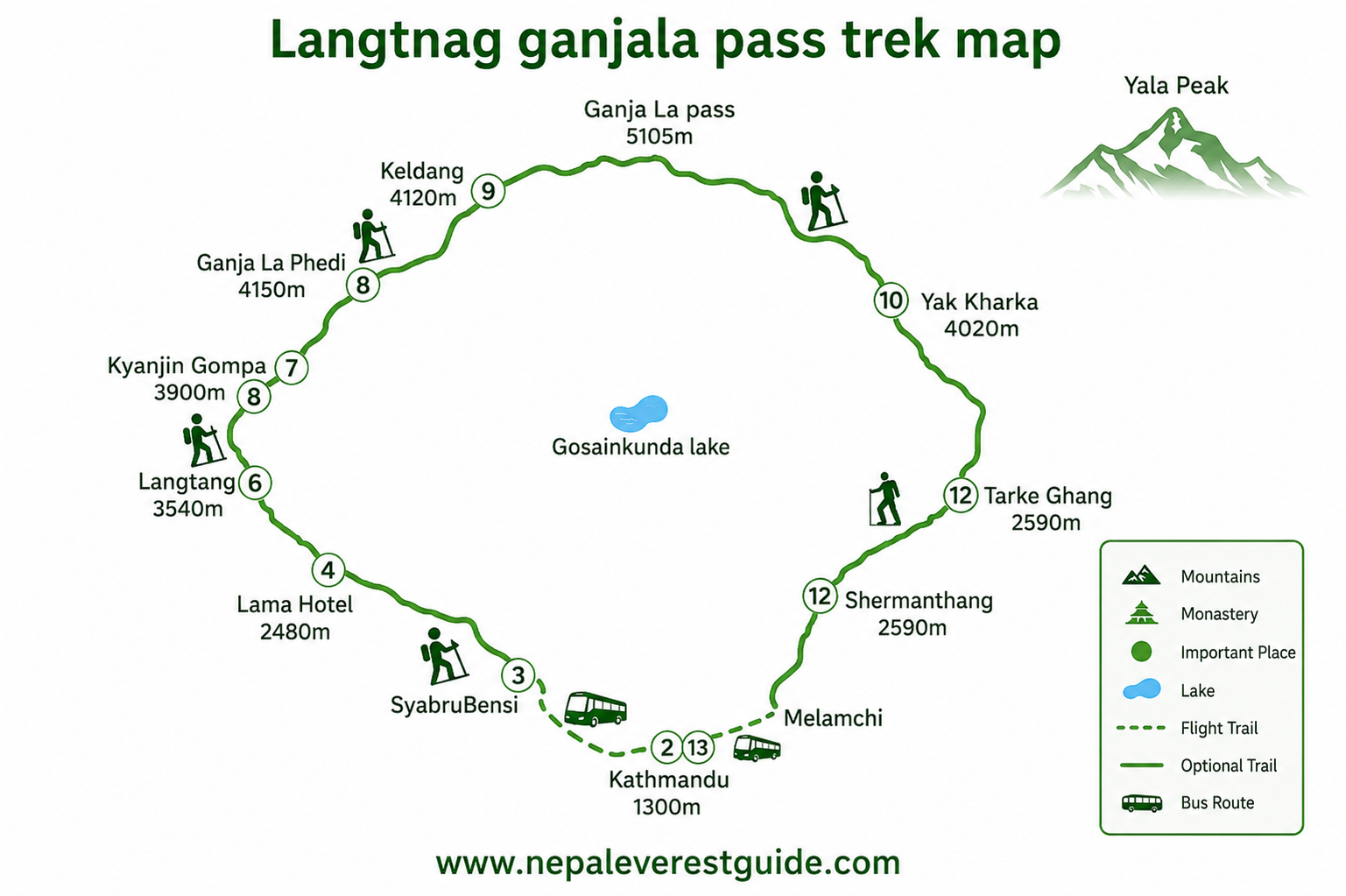
The Langtang Trek Route Map shows the complete trekking route from Syabrubesi to Kyanjin Gompa and back. The journey begins with a drive from Kathmandu to Syabrubesi, the starting point of the trek. The trail passes through Domen, Pairo, Bamboo, Rimche, Lama Hotel, Ghodatabela, Langtang Village, and Mundu before reaching Kyanjin Gompa. From Kyanjin Gompa, many trekkers hike to Kyanjin Ri or Tserko Ri for stunning views of the Langtang Himalayas. After exploring the area, the route follows the same trail back to Syabrubesi, where the trek ends.
Langtang Trek Distance and Walking Hours:
The Langtang Trek covers about 65–75 km (40–47 miles) round trip, depending on your itinerary and side hikes. Most trekkers complete the journey in 7 to 10 days, starting and ending at Syabrubesi. The route passes through Lama Hotel, Langtang Village, and Kyanjin Gompa.
On average, you will walk 5 to 7 hours each day. Some days are shorter, while the hike to Kyanjin Ri or Tserko Ri takes extra time but rewards you with spectacular Himalayan views. Walking at a steady pace helps you enjoy the trek and adjust to the increasing altitude.
Langtang Valley Trek Difficulty Level:
The Langtang Valley Trek is a moderate trek suitable for beginners with good fitness as well as experienced trekkers. The trail follows well-marked paths through forests, villages, and mountain valleys. However, there are many uphill and downhill sections, and you will walk 5–7 hours on most days.
The highest overnight stop is Kyanjin Gompa (3,870 m), while optional hikes to Kyanjin Ri (4,773 m) or Tserko Ri (4,984 m) are more challenging because of the steep climb and high altitude. No technical climbing skills are needed, but good physical preparation and proper acclimatization are important to reduce the risk of altitude sickness.
Best Time for the Langtang Valley Trek with a Local Guide:
The best time for the Langtang Valley Trek is during spring (March to May) and autumn (September to November). These seasons offer clear mountain views, pleasant temperatures, and colorful landscapes. In spring, the trail is filled with blooming rhododendron forests, while autumn provides dry weather and excellent visibility of Langtang Lirung and surrounding Himalayan peaks. A local guide helps you choose the best routes and shares interesting stories about the region.
Although the trek is possible in winter (December to February), it can be very cold at higher elevations, and snowfall may affect the trails. The monsoon season (June to August) brings frequent rain, slippery paths, and cloudy views. Trekking with a local Langtang guide during any season improves your safety, helps you understand the Tamang culture, and ensures a more enjoyable and well-organized trekking experience.
Langtang Trek Cost – 8 Days Package with a Freelance Guide in Nepal
The Langtang Trek 8-day package with a freelance guide in Nepal is an affordable option for trekkers who want a personal and flexible experience. The average cost ranges from USD 380 to USD 650 per person, depending on your group size, transportation, accommodation, and the services included. Most packages cover a licensed local guide, Langtang National Park Permit, TIMS card (if required), tea house accommodation, local transportation between Kathmandu and Syabrubesi, and the guide's food, salary, and insurance.
Choosing a freelance Langtang guide often costs less than booking through a large agency while still providing professional service and local knowledge. Extra expenses such as meals, drinks, Wi-Fi, hot showers, charging devices, and personal trekking gear are usually not included. Hiring an experienced local guide makes the trek safer, supports the local economy, and helps you enjoy the culture, nature, and mountain scenery of the Langtang Valley.
Accommodation on the Langtang Trek:
Accommodation on the Langtang Trek is comfortable, clean, and welcoming. You will stay in local tea houses that offer private twin-sharing rooms with two single beds, comfortable mattresses, clean pillows, warm blankets, and basic furniture. The rooms are simple but safe, making them ideal for a good night's rest after a day of trekking. Most tea houses have shared bathrooms, while some lodges offer attached bathrooms at lower elevations.
The tea houses are run by friendly local families who provide warm hospitality and freshly prepared meals every day. You can enjoy a variety of fresh Nepali and international dishes, including Dal Bhat, fried rice, noodles, soups, momos, pancakes, eggs, and hot drinks. The welcoming atmosphere, peaceful mountain setting, and genuine local hospitality make your stay in the Langtang Valley both comfortable and memorable.
Required Trekking Permits and Fees for the Langtang Valley Trek:
Every trekker must obtain the necessary permits before starting the Langtang Valley Trek. These permits help protect the natural environment, support conservation projects, and maintain the trekking trails inside Langtang National Park. You should carry your permits and passport throughout the journey, as they are checked at several entry points and villages along the route.
The most important permit is the Langtang National Park Entry Permit, which is mandatory for all foreign visitors. Depending on the latest trekking regulations and your travel arrangement, you may also need a TIMS Card (Trekkers' Information Management System). If you book your trek with a local guide or trekking company, they can arrange all the required permits before your departure, allowing you to enjoy a smooth and hassle-free trekking experience.
Current Permit Fees:
- Langtang National Park Entry Permit: NPR 3,000 per foreign trekker
- SAARC Nationals: NPR 1,500 per person
- TIMS Card: Apply only if required under the latest trekking regulations
Obtaining the correct permits not only ensures compliance with Nepal's trekking regulations but also contributes to the conservation of wildlife, trail maintenance, and the sustainable development of local communities in the Langtang Valley. Traveling with a licensed local guide makes the permit process simple while adding valuable local knowledge and enhancing your overall trekking experience.
Transportation from Kathmandu to Syabrubesi and Return Journey:
The journey from Kathmandu to Syabrubesi, the starting point of the Langtang Valley Trek, takes approximately 7–9 hours by road. You can travel by local bus, shared jeep, or private jeep, depending on your budget and comfort. A private jeep is the fastest and most comfortable option, especially for small groups.
The scenic drive passes through Trishuli Bazaar, riverside villages, terraced farms, and beautiful mountain landscapes. Along the way, there are several stops where you can enjoy refreshments and short breaks.
After completing the trek, you will return to Syabrubesi and drive back to Kathmandu using the same route. Most trekkers choose a private jeep for the return journey because it is more comfortable after several days of hiking and offers a flexible travel schedule.
Jeep vs Bus to Syabrubesi:
A private jeep is the most comfortable and fastest way to reach Syabrubesi, taking around 7–8 hours with flexible departure times and fewer stops. A local bus is a budget-friendly option that usually takes 8–10 hours and can be crowded, especially during peak trekking seasons. For greater comfort, convenience, and a smoother ride, most trekkers prefer a private jeep.
Altitude Sickness on the Langtang Trek:
The Langtang Valley Trek reaches an altitude of around 4,984 m (16,352 ft) at Tserko Ri, where the air becomes thinner and some trekkers may experience Altitude Sickness (Acute Mountain Sickness - AMS). Common symptoms include headache, dizziness, loss of appetite, nausea, and difficulty sleeping. Walking at a steady pace, drinking plenty of water, and allowing your body enough time to acclimatize greatly reduce the risk.
Trekking with a licensed local guide adds an extra layer of safety, as they can recognize the early signs of AMS and take the necessary action if symptoms develop. Taking regular breaks, avoiding alcohol, eating nutritious meals, and spending a night at Kyanjin Gompa before hiking to higher viewpoints help your body adjust to the altitude and make your Langtang Trek safer and more enjoyable.
Internet, WiFi, and Mobile Network on the Langtang Trek:
Staying connected during the Langtang Valley Trek is possible, although the service becomes less reliable as you gain altitude. Most tea houses offer WiFi for a small additional fee, allowing trekkers to send messages, check emails, and share travel updates. However, internet speed may be slow, especially during busy trekking seasons.
Both NCELL and Nepal Telecom (NTC) provide mobile network coverage in many parts of the Langtang region, including Syabrubesi, Lama Hotel, Langtang Village, and Kyanjin Gompa. The signal can be weak or unavailable in some remote sections of the trail, so it is best to download maps and important information before your trek. A local SIM card with a data package is a convenient and affordable option for staying connected throughout the journey.
Packing List for the Langtang Trek:
Packing the right gear will make your Langtang Valley Trek more comfortable and enjoyable. Since the weather can change quickly in the Himalayas, it is best to pack light while carrying all the essentials.
- Comfortable trekking boots with good grip
- Warm down jacket and fleece jacket
- Waterproof jacket and rain cover
- Thermal base layers for cold mornings and nights
- Quick-dry trekking shirts and trekking pants
- Warm hat, sun hat, gloves, and wool socks
- Sleeping bag (recommended for winter and colder months)
- Daypack (25–35L) with a rain cover
- Reusable water bottles or a hydration bladder
- Water purification tablets or a water filter
- Sunglasses, sunscreen (SPF 50+), and lip balm
- Headlamp with extra batteries
- Personal toiletries and a small first-aid kit
- Passport, trekking permits, cash, and travel insurance
- Power bank, charging cable, and your mobile phone
- Trekking poles for better balance on steep trails
A well-planned packing list helps you stay safe, comfortable, and prepared for the changing conditions of the Langtang Valley Trek without carrying unnecessary weight.
Cancellation Note
- Free cancellation up to 60 days prior departure
- 30% of the total cost of the trip will be charged if cancelled between 60 to 30 days prior to departure date
- 60% of total cost of the trip will be charged if cancelled in between 30 to 14 days prior to departure date.
Web design & Developed by Wildstone Solution
